German Records Certificate
Have you found your German ancestors? Are you bewildered with the language, writing, and different records that are available for your research?…
Have you found your German ancestors? Are you bewildered with the language, writing, and different records that are available for your research?…
For the month of April, we have highlighted some of the 225+ genealogy and research courses offered at The International Institute of Genealogical Studies. There are a variety of themes and topics to choose from. Hopefully, we will feature some courses that you were not aware of and pique your interest to explore further. G is for GERMAN Continuing with another specific European focus, The National Institute offers German Records courses, packages, and certificates. Be sure to check out the certificate options with three combination certificates using German Records courses. If you have German roots, you will want to utilize these online education resources to build your German Research Toolbox. Looking for an overview? A good starting point to begin your German research in this course: Research: German Ancestors German Records Courses Basic Level German: Church Records German: Introduction to German Research German: Locating Places in Germany German: The Language Intermediate Level German: Chronological Considerations German: Civil Registration Records German: Emigration Records German: Reading the Records German: Record Repositories Advanced Level German: Compiled Sources German: Germans Outside of Germany German: Naming Practices Additional Course Packages You can customize your own package of courses. This is especially helpful if you have already completed some of the German Record courses. Register for the balance of the courses needed to complete your desired certificate. Research A-Z By focusing our research on one specific location, we begin to understand the records created and where to find them. Languages can be challenging, but tools are provided to recognize genealogical terms and use online tools. Naming patterns and practices unique to each region become easier to identify as we familiarize ourselves with all aspects of the research involved to accomplish the goals of our project. Enjoy your German research journey! The International Institute of Genealogical Studies offers quality online education with over 240 courses. Our wide range of courses cover specific countries, enhance methodology research, build skills to maximize your research time, and all count toward the certification you choose. Follow us on Social Media: Blog, Facebook, Twitter, Pinterest, YouTube. *Note: Please be aware our social media accounts are monitored regularly, but not 24/7. If you have any questions, please contact the office directly. Contact information:1 (800) 580-0165Email: admin@GenealogicalStudies.com Website: www.GenealogicalStudies.comBlog: blog.GenealogicalStudies.com LEADERS IN ONLINE GENEALOGY EDUCATION since 1997
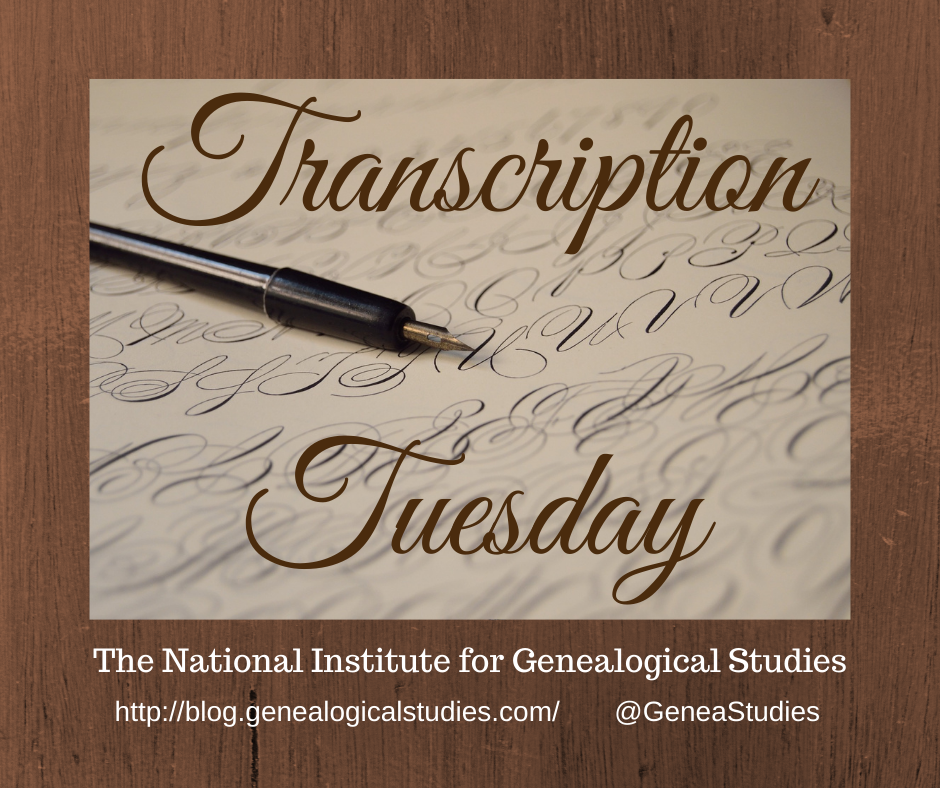
The National Institute for Genealogical Studies provides online genealogical education for those interested in a wide variety of topics, including those who are faced with reading records in a language that is unfamiliar to them. Whether you are just beginning to research your family history, or you are a professional genealogist, sooner or later, you will face this challenge. One of the foundational research skills to develop is Transcribing. However, it is difficult to transcript documents in other languages. Transcriptions still need to be created by family history researchers, and often in both languages. For this reason, we have created courses to address some of these challenges. Reading German Records There are two National Institute for Genealogical Studies courses from our German Records Certificate, which deal with German Handwriting and Transcribing Records written in the German language. The first course is German: The Language. This National Institute for Genealogical Studies basic level course introduces the key information needed about the German language so researchers can be successful in reading German records. Read Course Description here The second course is German: Reading the Records. This National Institute for Genealogical Studies intermediate level course provides a detailed discussion and explanation of the old style of German handwriting. Read Course Description here This course requires the purchase of a Compulsory Textbook titled: Deciphering Handwriting in German Documents: Analyzing German, Latin, and French in Vital Records Written in German by Author: Roger P. Minert (2001, 182 pp). It includes a short history of handwriting styles in Germany, detailed separate methodologies for deciphering German, Latin and French vital records, computerized alphabet for old German characters representing the old Fraktur and Gothic handwriting alphabets, and more than 150 illustrations with 131 sample texts. Book is available in our online Genealogy Store. Both courses are part of our German Certificate Program. This can be purchased as a 40-course package, which includes all of the compulsory and elective courses required to complete the Certificate in Genealogical Studies for German Records. Practical Resources for German Handwriting Germany Handwriting – FamilySearch Handwriting Guide: German Gothic – FamilySearch List of Names in Old German Script – BYU Script Tutorial A comprehensive list of German given names, written in old script, with possible variations. Old German Script Transcriber – Deutsche Handschriften This is a very useful webpage. See how your family names were written in the script of their era. Type your name or other word into the font generator tool. Click on one of the 8 different fonts. You can…
Continuing to post Congratulations to Our Recent Graduates **Please see previous blog post with a Message from The National Institute for Genealogical Studies to all recent graduates. What an impressive achievement! It took a lot of hard work, patience, and determination to reach your goal. It is time to celebrate the success of all our recent graduates. We are so very proud of all of you. Introducing the Graduates of the German Records Certificate be between June 2019 and October 2021. GERMAN CERTIFICATE Bette Bohman, PLCGS Elisabeth Gatlin, PLCGS Debra Hoffman, PLCGS Eric William Kopittke, PLCGS Eva Kujawa, PLCGS Christine Murphy, PLCGS Margaret Roxborough, PLCGS Stephen Van Bibber, PLCGS Justina Vickerman, PLCGS Heather Weaver, PLCGS Warmest congratulations to all our graduates… Louise St Denis and our team at The National Institute for Genealogical Studies ~~~~~~~~~~~~~~~ Graduates have completed all requirements for our 40-course German Records Certificate, which includes the following compulsory German Records courses: Basic Level German: Church Records German: Introduction to German Research German: Locating Places in Germany German: The Language Intermediate Level German: Chronological Considerations German: Civil Registration Records German: Emigration Records German: Reading the Records German: Record Repositories Advanced Level German: Compiled Sources German: Germans Outside of Germany German: Naming Practices ~~~~~~~~~~~~~~~ To recognize all of our graduates throughout the years, please go to our website at www.genealogicalstudies.com, click on the menu item INSTITUTE, and then GRADUATES. Be patient, the list is long and therefore takes time to display. For a full list of Certificates from The National Institute for Genealogical Studies, please visit our website. —————————————————-Visit our website for a complete list of online courses offered by The National Institute for Genealogical Studies. Check our Course Calendar here. Follow us on Social Media: Blog, Facebook, Twitter, Pinterest. *Note: Please be aware our social media accounts are monitored regularly, but NOT 24/7. If you have any questions, please contact the office directly. Contact information:1 (800) 580-0165Email: admin@GenealogicalStudies.com Website: www.GenealogicalStudies.comBlog: blog.GenealogicalStudies.com LEADERS IN ONLINE GENEALOGY EDUCATION since 1997
By Michele Simmons Lewis, Student In the course German: Civil Registration Records, the first thing you will learn is what types of civil records the German-speaking countries generate and where you can find them. Finding them is not as easy as it sounds. Every local jurisdiction has its own Standesamt (civil registry office). You have to know exactly where your ancestor lived to find his/her records. Since I had already taken the German: Locating Places in Germany course this was familiar territory. German gazetteers like Meyers Orts- und Verkehrs-Lexikon des Deutschen Reichs will help you find the correct jurisdiction. Civil registration started early on, as early as 1792 in some places, so this is a great source for birth , marriage, and death certificates (Geburtsurkunden, Heiratsurkunden und Sterbeurkunden). In the second module of this course you learn what sort of information you can expect to find in these records. German civil records are fairly uniform across the different jurisdictions and contain a lot of genealogical data. Many Standesamts used typeset, fill-in-the blank forms which usually makes them easier to read than church records of the same time period. Many of Germany’s civil records have been microfilmed by the Family History Library (FHL). The FHL’s FamilySearch website is starting to upload some of these microfilms online as they are being digitized (check the Records collection for Germany). Don’t make the mistake of thinking that what you see on FamilySearch is all there is. You must also check the FamilySearch Catalog. You can order microfilms and they will be sent to the Family History Center nearest you where you can view them. With my own family I have been very lucky. The Köln Archives has put digital images of their holdings online. They aren’t complete yet but this has been a goldmine for me because my family has been in the Köln area since the early 1700s. The records are not indexed as a whole but each individual book is indexed so that helps. The biggest problem is the one I mentioned at the beginning of this post; there are Standesamts for every local jurisdiction. Köln is a big city and it is divided up into many districts, each with its own Standesamt. One really nifty thing you will see on German civil records that you won’t see on American ones is a chain of documents. For example, if you find a…